
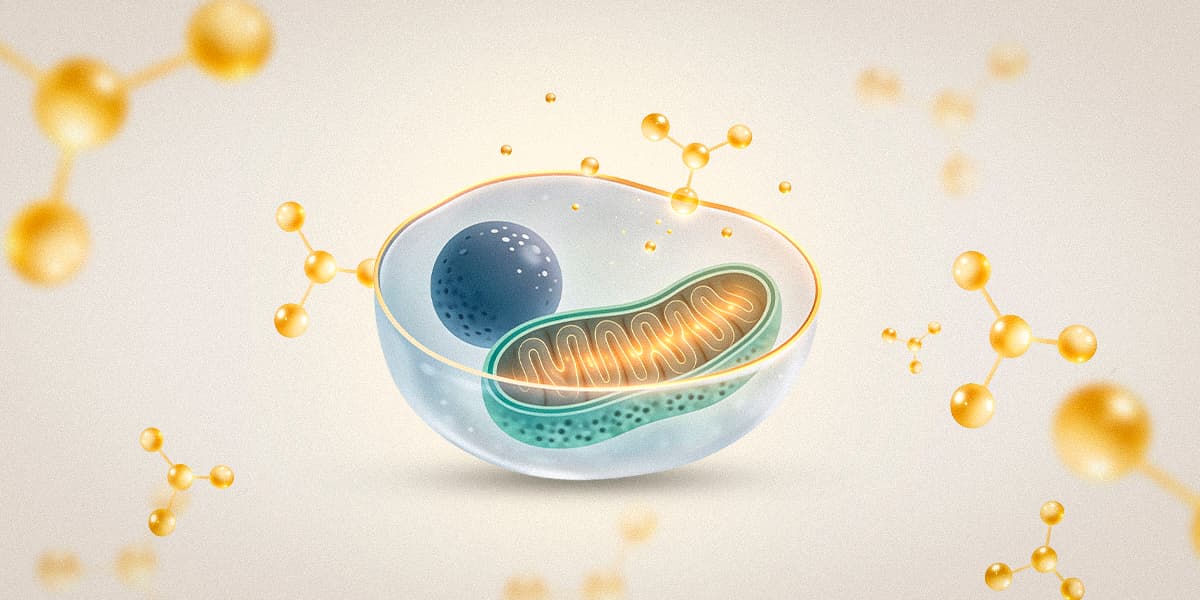
Many women in their 40s describe the same pattern. The morning goes well, but by mid-afternoon their focus slips and their bodies feel heavier, even after a full night's sleep. Many things can cause this, and one starts at the cellular level, with how the body produces energy. This guide explains mitochondrial health: what mitochondria do, what “cellular energy” really means, and which everyday habits help support it.
What mitochondria do in your body
Mitochondria are small structures found inside almost every cell in the body. Their main job is to turn the food we eat and the oxygen we breathe into energy that cells can use [1]. That’s why biology textbooks often call them “the powerhouses of the cell.”
Not every cell has the same number of mitochondria. Cells that work harder, such as muscle, heart, and brain cells, have more. This helps explain why cellular energy matters for so much of daily life, from how a workout feels to how well we focus at work.
What “cellular energy” actually means
Cellular energy is what cells use to do their work, whether that’s contracting a muscle, sending signals between nerve cells, or repairing tissue. A molecule called adenosine triphosphate (ATP) carries most of this energy [1].
The body keeps only a small supply of ATP on hand, so it constantly makes more and uses it almost as fast. When scientists discuss cellular energy, they usually mean how well cells meet that demand.
From food to ATP: the assembly line
The process works a bit like an assembly line. First, the body breaks down carbohydrates, fats, and proteins from food into smaller molecules. Then, inside the mitochondria, those molecules go through a series of chemical reactions that release high-energy electrons [1].
In the final stage, those electrons move along a chain of proteins in the inner mitochondrial membrane. This movement drives ATP production, and oxygen receives the electrons at the end of the chain. This last step produces most of the body’s ATP [1].
Where NAD+ and CoQ10 fit in
Two molecules are especially important in this process. The first is NAD+, a coenzyme found in every living cell. It collects electrons from food molecules and carries them to the chain that drives ATP production [1, 2]. NAD+ also supports other cellular processes, including DNA repair [2].
The second is coenzyme Q10 (CoQ10). The body makes it naturally, and it sits in the inner mitochondrial membrane, where it carries electrons from one part of the chain to the next. CoQ10 also acts as an antioxidant, helping protect cells from oxidative stress [3].
Why energy can feel different in your 40s
Several changes can happen around midlife, and they often overlap. Research suggests NAD+ levels tend to decline with age, more clearly in some tissues than in others [2], and the body’s own CoQ10 production often drops over the years [3, 4]. Scientists are still studying how large these changes are and whether they affect people's daily energy levels.
Other factors play a part too. Muscle mass tends to decline gradually with age unless it’s maintained [5], and muscle is one of the tissues richest in mitochondria. For many women, the menopausal transition also brings hormonal changes that can disrupt sleep [6], the time when much of the body’s recovery happens. On top of that, this is often a busy stage of life, with demanding jobs, teenage children, and aging parents.
These changes are a normal part of getting older, and they help explain why a routine that worked well at 35 may not feel the same a decade later. Still, ongoing fatigue isn’t always about age. It can also have medical causes, such as thyroid problems, low iron, or sleep disorders, so if rest doesn’t help, it’s a good idea to talk to a doctor.

THE LUJEVIT ROUTINE
Two capsules. With your first meal.
See the six-ingredient formula, the full label and the supply options before you choose.
30-day money-back guarantee
Everyday habits that support mitochondrial health
Mitochondria respond to daily habits. The evidence is strongest for exercise, but sleep and diet matter too.
Movement and strength training
Regular exercise is one of the clearest ways to support mitochondrial health. When you use your muscles regularly, the body responds by making more mitochondria and helping them work better [7]. Aerobic activities like brisk walking, cycling, or swimming are especially good at this. Strength training, in turn, helps preserve muscle mass, which matters more with age [5]. For most people, three or four sessions a week that mix walking, Pilates, and light weights are a realistic place to start.
Sleep and recovery
During sleep, the body does much of its repair work. When sleep is light or often interrupted, people can wake up tired even after enough hours in bed. Going to bed and waking up at similar times each day can help. So can limiting alcohol, which many people find disrupts their sleep more after 40, and having the last coffee of the day by early afternoon.
What you eat
Mitochondria make energy from the food we eat, so diet matters. Getting enough protein helps maintain muscle, one of the tissues richest in mitochondria. B vitamins are also important, especially niacin (vitamin B3), which the body uses to make NAD+ [8]. Niacin is found in chicken, fish, beans, and whole grains [8]. Colorful fruits and vegetables, such as berries, leafy greens, and grapes, provide polyphenols, which are plant compounds with antioxidant properties. Eating at regular times, instead of going long stretches without food, can also help keep energy steadier throughout the day.
Where supplements fit, and where they don’t
No supplement can replace exercise, good sleep, and a balanced diet. Those habits come first.
When it comes to NAD+, human studies show that precursors, the building blocks the body uses to make NAD+, can raise NAD+ levels. One example is nicotinamide riboside (NR), another form of vitamin B3 [9]. What’s less clear is whether that increase leads to specific health benefits over time. So far, the results have been mixed, and researchers say more studies are needed [10].
For people who already cover the basics, a supplement can be a simple way to get more of the compounds cells use to make energy. Lujevit was designed with that in mind. It combines NR with five other compounds linked to cellular health, including CoQ10, in one daily dose: two capsules with the first meal of the day. That means one bottle instead of several. Lujevit is made in the USA at a GMP-certified facility, vegan and non-GMO, and third-party tested. It also comes with a 30-day satisfaction guarantee.
Lujevit is not recommended during pregnancy or breastfeeding. People who have a medical condition or take medication regularly should talk to their doctor before starting any supplement. Lujevit is intended for adults 18 and older and should be kept out of reach of children.
Frequently asked questions
What is cellular energy?
Cellular energy is the energy cells use to do their work, such as moving muscles, sending nerve signals, and repairing tissue. A molecule called ATP carries most of it, and the mitochondria produce most of the body’s ATP [1].
What does mitochondrial health mean?
Mitochondrial health describes how well the mitochondria turn food and oxygen into usable energy. Exercise, sleep, and diet can all influence it, though the evidence is strongest for exercise.
Do NAD+ levels really go down with age?
Research suggests that NAD+ levels tend to decline with age, more clearly in some tissues than in others [2]. Scientists are still studying how much this varies from person to person.
Can a supplement replace a healthy lifestyle?
No. Supplements can support a routine, but they don’t replace exercise, sleep, and a balanced diet.
When should I take Lujevit?
Take two capsules a day, preferably with your first meal, or as directed by a healthcare professional.
References
BCcampus. Concepts of Biology, 1st Canadian Edition. Chapter 4.3: Citric Acid Cycle and Oxidative Phosphorylation. [Link]
Covarrubias AJ, Perrone R, Grozio A, Verdin E. NAD+ metabolism and its roles in cellular processes during ageing. Nature Reviews Molecular Cell Biology. 2021;22:119–141. [DOI] [PMC free article] [PubMed]
Barcelos IP, Haas RH. CoQ10 and Aging. Biology (Basel). 2019;8(2):28. [DOI] [PMC free article] [PubMed]
Kalén A, Appelkvist EL, Dallner G. Age-related changes in the lipid compositions of rat and human tissues. Lipids. 1989;24(7):579–584. [DOI] [PubMed]
Rodrigues F, Domingos C, Monteiro D, Morouço P. A Review on Aging, Sarcopenia, Falls, and Resistance Training in Community-Dwelling Older Adults. International Journal of Environmental Research and Public Health. 2022;19(2):874. [DOI] [PMC free article] [PubMed]
Baker FC, de Zambotti M, Colrain IM, Bei B. Sleep problems during the menopausal transition: prevalence, impact, and management challenges. Nature and Science of Sleep. 2018;10:73–95. [DOI] [PMC free article] [PubMed]
Perry CGR, Hawley JA. Molecular Basis of Exercise-Induced Skeletal Muscle Mitochondrial Biogenesis: Historical Advances, Current Knowledge, and Future Challenges. Cold Spring Harbor Perspectives in Medicine. 2018;8(9):a029686. [DOI] [PMC free article] [PubMed]
National Institutes of Health, Office of Dietary Supplements. Niacin: Fact Sheet for Health Professionals. [Link]
Martens CR, Denman BA, Mazzo MR, et al. Chronic nicotinamide riboside supplementation is well-tolerated and elevates NAD+ in healthy middle-aged and older adults. Nature Communications. 2018;9:1286. [DOI] [PMC free article] [PubMed]
Gao Y, Li S, Guan J, Yin Y, Kong X, Yu L. Domain-specific effects of NAD+ precursors on fatigue and functional performance: a systematic review and network meta-analysis. Frontiers in Nutrition. 2026;13:1890335. [DOI]
This article is for educational purposes and is not medical advice.
These statements have not been evaluated by the Food and Drug Administration. This product is not intended to diagnose, treat, cure, or prevent any disease.

Share this post