
A spoonful of wheat germ on your yogurt. A side of green peas. A handful of mushrooms tossed into the pan. What do they have in common? Each one carries a small molecule your cells already know well: spermidine.
So, what is spermidine? It's a natural compound found in every living cell, and it plays a part in one of the body's most important housekeeping routines. Over the past 15 years or so, it has gone from a niche topic in cell biology to a name you see on supplement labels.
That jump raises a fair question: how much of the buzz is backed by science? In this guide, we'll follow the research step by step—from the lab bench to human studies—and look at what spermidine does, where to find it in food, and what's still unknown.
What is spermidine?
Spermidine belongs to a family of small molecules called polyamines, named for the several nitrogen-based chemical groups, known as amines, that they carry. Cells use it to keep their basic machinery running. It helps stabilize DNA and RNA, supports cell growth, and influences how cells respond to stress.
Its story starts with a microscope. In 1678, Antonie van Leeuwenhoek described tiny crystals in a sample of human seminal fluid. Two centuries later, scientists named the compound behind them spermine, after where it was first seen. Its close relative, spermidine, was identified in 1927 and got a similar name [1]. The name stuck, even though these molecules turned out to be everywhere—in plants, fungi, bacteria, and every cell of the human body.
Your body gets spermidine from three sources:
Your own cells, which make it from amino acids.
Your diet, since many plant foods contain it, especially wheat germ, legumes, and mushrooms.
Your gut bacteria, which produce polyamines as part of their own metabolism.
Researchers have reported that spermidine levels tend to decline with age in some tissues, though not in all. That observation is one reason scientists became curious, much like their interest in other molecules that shift with age, such as NAD+, the coenzyme behind every NAD supplement.
What spermidine does in your cells
Picture a busy kitchen at the end of a long dinner service. Worn-out tools, scraps, and broken equipment pile up. If nobody clears them away, the kitchen slows down. Cells face the same problem every day, and their cleanup crew has a name: autophagy.
Autophagy, from the Greek for "self-eating," is the process cells use to break down damaged proteins and worn-out parts and recycle them into fresh building blocks. It's a normal, constant part of keeping cells healthy.
This is where spermidine comes in. In lab studies, spermidine is one of the best-described natural compounds that switch autophagy on. Scientists have mapped two main routes:
It changes chemical "tags" on proteins. Spermidine reduces acetylation, the process of adding small chemical tags that cells use as on/off switches. With fewer of these tags on certain proteins, the recycling process switches on.
It feeds a protein called eIF5A. Cells use spermidine to activate eIF5A, which helps produce TFEB, a master regulator of the cell's recycling machinery.
In short, what does spermidine do? In aging research, its most-studied role is helping regulate autophagy, a routine process cells use to maintain themselves. That's a mechanism, not a guaranteed outcome, and the next section shows why that difference matters.
Spermidine benefits: what the research shows
When people search for spermidine benefits, they often find bold headlines. The real story is more nuanced and more interesting. The evidence comes in three layers, and each one answers a different question.
The autophagy connection
The modern chapter began in 2009, when a team led by researchers in Graz, Austria, published a Nature Cell Biology study showing that spermidine triggered autophagy in yeast, worms, flies, and human cells, and extended the lifespan of yeast, worms, and flies [2]. When the researchers switched off key autophagy genes in those organisms, spermidine no longer extended their lifespan.
That detail is the heart of the science. It suggests spermidine works mainly through the cell's own recycling system rather than acting on its own. It also explains why researchers mention spermidine in the same breath as healthy aging: autophagy is one process that tends to become less efficient over time.
Findings from animal studies
In 2016, the same research network tested spermidine in mice. In the study, published in Nature Medicine, researchers added spermidine to the animals' drinking water and reported [3]:
Better-preserved heart structure and function in older mice, including less age-related thickening of the heart muscle.
A longer median lifespan in supplemented mice, including those that started supplementation late in life.
No heart benefit in mice genetically unable to run autophagy in their heart cells, which again pointed to autophagy as the mechanism.
These results are striking, but they're mouse results. Lab animals live in controlled conditions, receive carefully measured doses, and differ from humans in metabolism and lifespan. Animal data tell scientists where to look next. They don't tell you what will happen in your own body.
What human studies have, and haven't, found
Human research on spermidine falls into two groups, and they point in different directions.
Observational studies. In the Bruneck Study, published in 2018 in the American Journal of Clinical Nutrition, researchers in northern Italy tracked the diets of 829 adults over two decades. People who ate more spermidine-rich foods had lower all-cause mortality, and the association held in a second, independent group [4]. But observational studies show links, not cause and effect. People who eat more whole grains, legumes, and vegetables may also differ in many other ways.
Clinical trials. The strongest test so far is the SmartAge trial, published in JAMA Network Open in 2022. Researchers gave 100 older adults with self-reported memory concerns either a spermidine-rich wheat germ extract or a placebo for 12 months. The result: no meaningful difference in memory or in the main biomarkers. The supplement was well tolerated, and the authors noted a few exploratory signals that need confirmation in larger studies, possibly at higher doses [5].
A 2025 trial in older men found that 40 mg a day of spermidine had only minimal effects on blood polyamine levels [6], a reminder that scientists are still working out how the body absorbs and uses it. Measuring autophagy directly in living people is also technically difficult, so the step from mechanism to measurable human outcome hasn't been confirmed yet.
Put together, here's the fair summary: spermidine is real, well-studied biology with a clear role in autophagy. Human research is promising in some areas, but limited in size and still evolving. It is not proof that spermidine slows aging or extends life in people.

THE LUJEVIT ROUTINE
Two capsules. With your first meal.
See the six-ingredient formula, the full label and the supply options before you choose.
$88.00 · 2 bottles / 60 days · Buy one, get one free · Black Friday30-day money-back guarantee
Foods high in spermidine
Let's go back to the wheat germ, green peas, and mushrooms from the start of this article. Spermidine is more common in food than most people think. The richest sources are plant foods, especially wheat germ, mushrooms, legumes, and seeds.
Here are some of the foods rich in spermidine, based on published food analyses:
Food | Approx. spermidine (mg per 100 g) |
|---|---|
Wheat germ | 33 |
Mushrooms | 13 |
Tempeh | 11 |
Soybeans | 10 |
Broad beans (fava beans) | 7 |
Sunflower seeds | 7 |
Natto (fermented soybeans) | 7 |
Green peas | 5 |
Sesame seeds | 5 |
Lentils | 4 |
Chickpeas | 4 |
Broccoli | 3.5 |
Cauliflower | 2.5 |
Source: Muñoz-Esparza N.C. et al., Foods, 2021 [7]. Values are averages for raw foods sold in Spain.
Treat these numbers as ballpark figures. Spermidine content varies by crop, growing conditions, and how food is stored and cooked. Lentils, for example, ranged from about 1.5 to 11 mg per 100 g across samples, and boiling or grilling cut polyamine levels by up to 64% in some foods [7].
A few easy ways to bring more of these foods to your plate:
Sprinkle a tablespoon of wheat germ on oatmeal, yogurt, or a smoothie.
Add edamame, chickpeas, or green peas to salads and grain bowls.
Use mushrooms in omelets, soups, and stir-fries.
Toss sunflower or sesame seeds into salads, or snack on a small handful.
Many of these foods are already staples of eating patterns linked with good health, like the Mediterranean diet, so they bring fiber, protein, and other nutrients along with their spermidine.
Getting spermidine from food vs. supplements
Everyone already gets some spermidine from food every day. The question is whether adding a supplement changes anything, and the science here calls for patience.
Food first. A varied diet with whole grains, legumes, mushrooms, and vegetables delivers spermidine together with fiber, vitamins, and other nutrients. It's also the kind of eating pattern behind the Bruneck Study findings.
Supplements: what we know. Many spermidine supplements are made from wheat germ extract, which naturally contains spermidine, while others use a purified form. Human trials have used very different amounts, from under 1 mg a day in the SmartAge trial to 40 mg a day in the 2025 study in older men. Both were well tolerated. SmartAge found no clear memory benefit, and the 2025 study focused on safety rather than benefits. Researchers are still working out how much spermidine the body absorbs and how it spreads to different tissues.
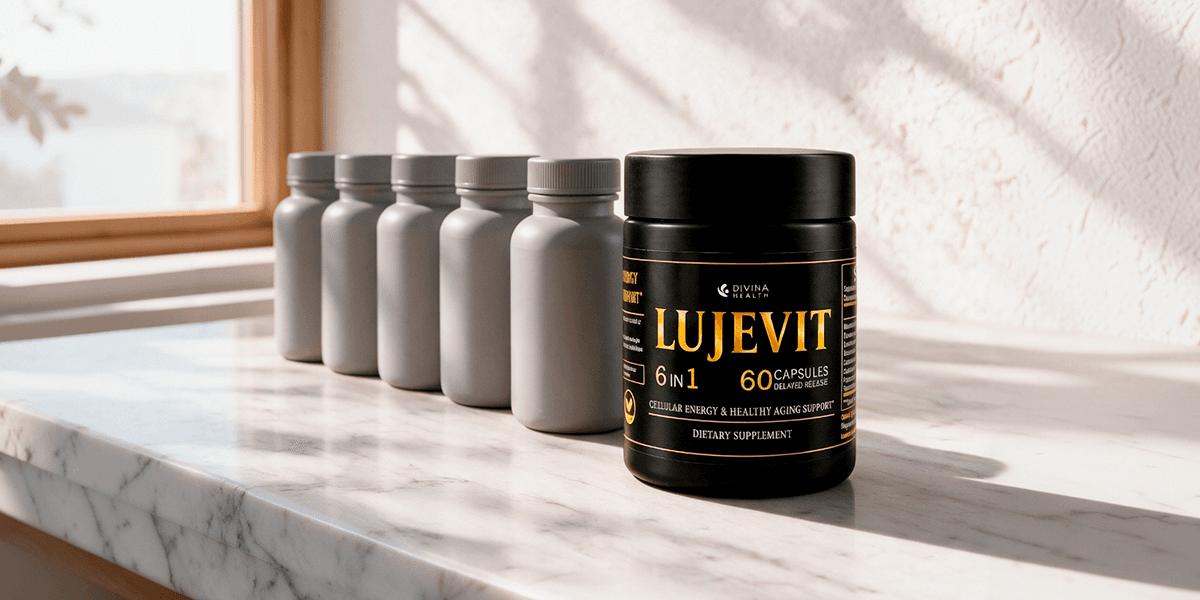
At Lujevit, spermidine is one of five compounds that, along with Nicotinamide Riboside—a precursor of NAD+—come together in a single daily supplement to support the cell's natural renewal processes.* The routine is simple: two capsules in the morning with your first meal.
If you have a pre-existing condition, take any medication, or are pregnant or breastfeeding, talk to your doctor before adding any supplement.
Frequently asked questions
What is spermidine in simple terms?
Spermidine is a natural compound in a family called polyamines, found in every living cell and many foods. It helps cells grow, stabilizes DNA and RNA, and supports autophagy, the process cells use to recycle worn-out parts.
What's spermidine made from?
Your cells make spermidine from amino acids through a few chemical reactions. You also get it from food and from the bacteria in your gut.
What does spermidine do in the body?
In aging research, spermidine's most-studied role is helping regulate autophagy, the cell's recycling process. In lab studies, spermidine switches on the cell's recycling machinery by changing chemical tags on proteins and by activating a protein called eIF5A.
Which foods are highest in spermidine?
Wheat germ is one of the richest common sources. Mushrooms, soybeans, legumes such as lentils, chickpeas, and green peas, and seeds such as sunflower and sesame are also good sources.
Can you get enough spermidine from food?
There is no official daily recommendation for spermidine, so there is no target to hit. A varied diet with whole grains, legumes, mushrooms, and vegetables naturally supplies it every day.
Does spermidine help you live longer?
Not in people, at least not yet. Spermidine has extended lifespan in yeast, worms, flies, and mice, and one long-running observational study linked diets richer in spermidine to lower mortality. But no clinical trial has shown that it slows aging or extends life in humans.
Is spermidine safe?
Spermidine is a normal part of the diet, and published human supplement trials have found it well tolerated. Long-term safety data for higher supplemental amounts are still limited, so check with your doctor if you have a health condition or take medication.
Does Lujevit contain spermidine?
Yes. Lujevit pairs Nicotinamide Riboside with five supporting compounds, and spermidine is one of them, included to support the cell's natural renewal processes.*
References
Dudley H.W. et al. The constitution and synthesis of spermidine, a newly discovered base isolated from animal tissues. Biochemical Journal, 1927. PMC
Eisenberg T. et al. Induction of autophagy by spermidine promotes longevity. Nature Cell Biology, 2009. PubMed
Eisenberg T. et al. Cardioprotection and lifespan extension by the natural polyamine spermidine. Nature Medicine, 2016. PubMed
Kiechl S. et al. Higher spermidine intake is linked to lower mortality: a prospective population-based study. American Journal of Clinical Nutrition, 2018. PubMed
Schwarz C. et al. Effects of spermidine supplementation on cognition and biomarkers in older adults with subjective cognitive decline (SmartAge). JAMA Network Open, 2022. PubMed
Supplementation of spermidine at 40 mg/day has minimal effects on circulating polyamines: an exploratory randomized controlled trial in older men, 2025. University of Greenwich repository
Muñoz-Esparza N.C. et al. Occurrence of polyamines in foods and the influence of cooking processes. Foods, 2021. PMC
This article is for educational purposes and is not medical advice.
*These statements have not been evaluated by the Food and Drug Administration. This product is not intended to diagnose, treat, cure, or prevent any disease.
Lujevit is not recommended for pregnant or breastfeeding women. If you have a pre-existing medical condition or take any medication, consult your doctor before use. Keep out of reach of children. For adults 18 and older.

Share this post