
 Lujevit Editorial Team
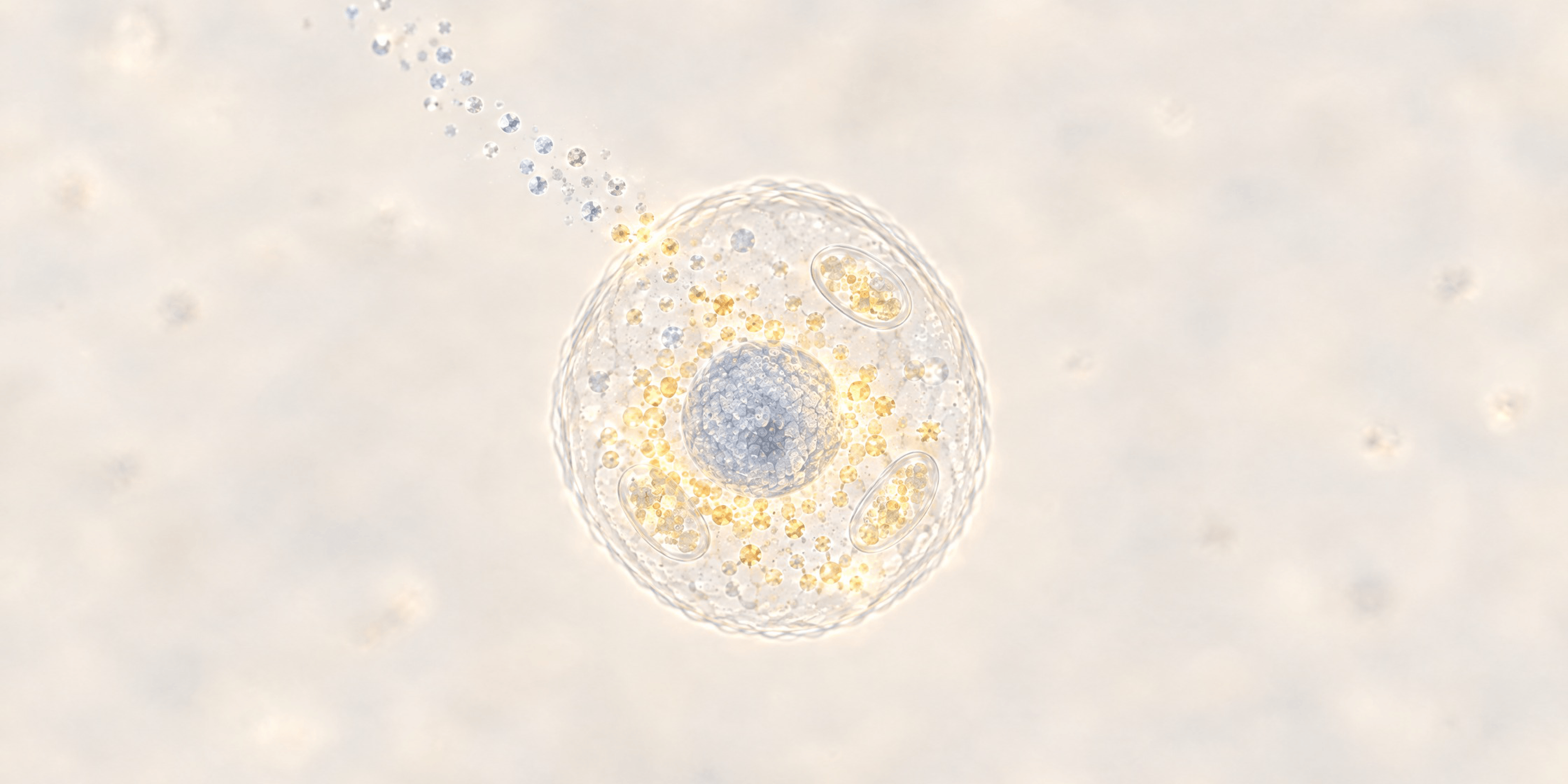
Nicotinamide riboside shows up on more and more supplement labels, usually as "NR" or "nicotinamide riboside chloride." It's the main ingredient in many NAD+ supplements, but the name explains very little on its own. This guide covers what nicotinamide riboside is, how your body turns it into NAD+, what studies have measured so far, and how it compares with the B3 forms you may already take.
The short answer: Nicotinamide riboside (NR) is a form of vitamin B3. Your cells use it as raw material to make NAD+, a coenzyme involved in turning food into energy. In human trials, taking NR by mouth has reliably raised NAD+ levels in the blood. Whether that leads to effects people notice or can measure in daily life is still being studied.
What Is Nicotinamide Riboside?
A form of vitamin B3
"Niacin" is the umbrella name for vitamin B3. It covers nicotinic acid, nicotinamide and related compounds, including nicotinamide riboside. Every form of B3 can feed your body's production of NAD+, but each one gets there by a different route.
NR is a relatively recent addition to that family. Nicotinic acid and nicotinamide were identified as vitamin B3 in the 1930s. In 2004, researchers showed that yeast and human cells can use nicotinamide riboside to make NAD+ through their own enzymes, and found NR as a nutrient in milk [1].
What "chloride" means on the label (NRCl)
On a supplement label, you'll usually see nicotinamide riboside chloride, sometimes shortened to NRCl. NR on its own isn't stable enough to manufacture reliably. Pairing it with chloride creates a stable salt that can be manufactured, measured and put into a capsule. This is the form used in most clinical research. One crystalline form of NR chloride has GRAS status for use in foods, and its maker has filed two New Dietary Ingredient notifications with the FDA for use in supplements [4].
Two practical points when you read a label:
The dose usually refers to the whole salt. When a label lists "500 mg nicotinamide riboside chloride," about 88% of that weight is NR itself and the rest is chloride. Many studies, including those using the NIAGEN ingredient, report their doses the same way, so you can compare labels with research directly.
It's made, not extracted. The NR chloride in supplements is obtained through chemical synthesis, with a purity of 90% or higher in the form the European Food Safety Authority evaluated [8]. That's normal for vitamins in supplements, and it's what makes precise dosing possible.
How NR Becomes NAD+ in Your Cells
Once NR reaches a cell, the path to NAD+ is short:
Uptake. NR enters cells through transporters in the cell membrane.
First conversion. Inside the cell, enzymes called nicotinamide riboside kinases (NRK1 and NRK2) add a phosphate group, turning NR into NMN.
Second conversion. Another enzyme turns NMN into NAD+.
This route matters because it's different from the one nicotinamide takes. Nicotinamide has to pass through an enzyme called NAMPT to become NMN, and the supply of NMN is a rate-limiting factor in NAD+ production. NR reaches NMN through its own enzymes instead. In lab studies of muscle cells, blocking NAMPT drained NAD+, and NR and NMN were able to restore it through the NRK pathway [6].
The real-world nuance: the route isn't always this clean in the body. Research, mostly in mice, suggests that much of the NR taken by mouth is converted in the small intestine into other forms of B3, with help from gut bacteria, before it reaches the rest of the body [10]. Blood NAD+ still rises reliably, as the next section shows. The route is just less direct than diagrams usually suggest.
Nicotinamide Riboside Benefits: What Studies Measured
When we talk about nicotinamide riboside benefits, we mean what researchers actually measured in people, not what marketing promises. Here's where the evidence stands.
Raising NAD+ levels
This is the best-established finding:
Trammell et al., 2016: In the first human pharmacokinetic study of NR, single doses of 100, 300 and 1,000 mg produced dose-dependent increases in blood NAD+ metabolites [2].
Martens et al., 2018: In a randomized, double-blind, placebo-controlled crossover trial in healthy middle-aged and older adults, six weeks of NR raised no safety concerns and increased NAD+ levels in blood cells [3].
Conze et al., 2019: In an eight-week placebo-controlled trial, 100, 300 and 1,000 mg of NR per day raised whole-blood NAD+ in a dose-dependent way within two weeks, and the increases lasted for the rest of the study [4].
In short, NR supports healthy NAD+ levels* when taken daily. Blood NAD+ metabolites rise within hours of a single dose [2], and daily use keeps levels raised, as the eight-week trial showed [4].
Tolerability in adults
NR has a solid tolerability record in studies so far:
In the eight-week Conze trial, there were no reports of flushing and no significant differences in adverse events between the NR and placebo groups [4].
Studies in healthy adults have tested doses from a single 100 mg dose up to 2,000 mg a day for 12 weeks, without safety concerns in vital signs or routine blood tests [8].
In the EU, the European Food Safety Authority (EFSA) assessed NR chloride as a novel food and found it safe for healthy adults at up to 300 mg a day, the amount the manufacturer applied for [8]. The 500 mg of NR chloride in Lujevit falls within the range tested in clinical trials, which have used up to 2,000 mg a day for 12 weeks [8].
Most trials have lasted weeks to a few months, so safety over many years isn't established yet. Because human data in pregnancy are limited, Lujevit is not recommended during pregnancy or breastfeeding. If you have a medical condition or take prescription medication, talk to your doctor before starting.
Outcomes still under study
The open question is what raising NAD+ does for how people feel and function. The honest answer is that it isn't clear yet:
Damgaard & Treebak, 2023: A critical review of 25 published human NR studies concluded that oral NR has shown few clinically relevant effects so far [5].
The most consistent signal across several trials has been lower inflammatory markers in blood.
Muscle: results are mixed. Most human trials found no rise in muscle NAD+ itself, and one five-month study reported more mitochondria in muscle without better metabolic health. Animal studies were more positive [5, 7].
Who's been studied: most trials have been small, focused on safety, and run in mostly healthy people. Longer studies in larger groups are still needed.
NR reliably does the first step, which is raising NAD+ in the blood. What follows from that is an active area of research, and we'd rather tell you that than promise more.
Nicotinamide Riboside vs. Nicotinamide and Niacin
All three are forms of vitamin B3, and all three can become NAD+. They differ in how they get there and in how they're tolerated.
Nicotinamide riboside (NR) | Nicotinamide (NAM, niacinamide) | Nicotinic acid ("niacin") | |
|---|---|---|---|
Route to NAD+ | Converted to NMN by its own enzymes (NRK1/2), without passing through NAMPT | Converted to NMN by NAMPT, the rate-limiting step | A separate pathway through other intermediates |
Flushing | None reported in an 8-week placebo-controlled trial | Doesn't cause flushing | Typically causes flushing at 30–50 mg or more |
At high doses | Trials up to 2,000 mg/day for 12 weeks raised no safety concerns; no toxicity threshold has been established for NR | Nausea, vomiting and signs of liver toxicity can occur at about 3,000 mg/day | Pharmacologic doses can cause more serious side effects and are used only under medical supervision |
Trials up to 2,000 mg/day for 12 weeks raised no safety concerns; no toxicity threshold has been established for NR | Nausea, vomiting and signs of liver toxicity can occur at about 3,000 mg/day | Pharmacologic doses can cause more serious side effects and are used only under medical supervision | |
Common use | NAD+ support supplements | Multivitamins and B-complex; skincare | Prescription use for blood lipids |
Nicotinamide riboside vs. nicotinamide: These two are closely related. As noted above, much oral NR becomes nicotinamide in the gut. The difference is mainly the route into the cell (NR doesn't need NAMPT) and the research focus: NR has been studied specifically as a way to raise NAD+, while nicotinamide is mostly studied as a vitamin.
Nicotinamide riboside vs. niacin: The practical difference most people notice is flushing. Nicotinic acid causes a warm, red, tingling flush. NR doesn't.
Food Sources vs. Supplements
You already get vitamin B3 from food. Poultry, beef and fish provide roughly 5–10 mg of niacin per serving, mostly as NAD and NADP, while nuts, legumes and grains provide about 2–5 mg per serving, mostly as nicotinic acid [9]. Your body also makes some NAD+ from tryptophan, an amino acid in protein.
NR itself is present in food, but only in small amounts. It was first identified as a nutrient in milk, specifically in the whey [1]. The amounts in a normal diet are tiny compared with the 100 to 2,000 mg a day tested in studies.
That points to the real difference between food and supplements. Food covers your basic B3 needs and prevents deficiency, and most people in the US already get enough. NR supplements serve a different purpose: they provide a specific NAD+ precursor in the amounts researchers have studied for raising NAD+ levels. One doesn't replace the other.
Frequently Asked Questions
Is nicotinamide riboside the same as niacin?
Not exactly. NR is one form of vitamin B3, and "niacin" is the umbrella term for the B3 family. In everyday use, though, "niacin" usually means nicotinic acid, the form that causes flushing. NR doesn't cause flushing. NR and NMN supplements also aren't marketed or labeled as sources of niacin.
Is nicotinamide riboside safe to take every day?
In clinical trials, daily NR has been well tolerated in healthy adults at doses up to 2,000 mg a day for as long as 12 weeks, with side effects similar to placebo. Long-term studies over many years haven't been done. Because human data in pregnancy are limited, Lujevit is not recommended during pregnancy or breastfeeding, and if you have a medical condition or take medication, check with your doctor first.
When is the best time to take nicotinamide riboside?
There's no strong evidence that one time of day works better than another. What matters in studies is daily, consistent use, because the studies that showed lasting increases used daily doses. Taking it at the same time each day, such as with breakfast, makes that easier to keep up.
How much nicotinamide riboside is in Lujevit?
Each serving of Lujevit (two capsules) contains 500 mg of nicotinamide riboside chloride, within the range used in human trials. It's paired with five compounds chosen for the systems NAD+ works with: CoQ10 to support mitochondrial energy production, quercetin phytosome, trans-resveratrol and pterostilbene for antioxidant support, and spermidine to support the cell's natural renewal processes.* Take two capsules with your first meal. See the full formula.
References
Bieganowski P, Brenner C. Discoveries of nicotinamide riboside as a nutrient and conserved NRK genes establish a Preiss-Handler independent route to NAD+ in fungi and humans. Cell. 2004;117(4):495–502. https://doi.org/10.1016/S0092-8674(04)00416-7
Trammell SAJ, et al. Nicotinamide riboside is uniquely and orally bioavailable in mice and humans. Nat Commun. 2016;7:12948. https://doi.org/10.1038/ncomms12948
Martens CR, et al. Chronic nicotinamide riboside supplementation is well-tolerated and elevates NAD+ in healthy middle-aged and older adults. Nat Commun. 2018;9:1286. https://doi.org/10.1038/s41467-018-03421-7
Conze D, Brenner C, Kruger CL. Safety and metabolism of long-term administration of NIAGEN (nicotinamide riboside chloride) in a randomized, double-blind, placebo-controlled clinical trial of healthy overweight adults. Sci Rep. 2019;9:9772. https://doi.org/10.1038/s41598-019-46120-z
Damgaard MV, Treebak JT. What is really known about the effects of nicotinamide riboside supplementation in humans. Sci Adv. 2023;9:eadi4862. https://doi.org/10.1126/sciadv.adi4862
Fletcher RS, et al. Nicotinamide riboside kinases display redundancy in mediating nicotinamide mononucleotide and nicotinamide riboside metabolism in skeletal muscle cells. Mol Metab. 2017;6:819–832. https://doi.org/10.1016/j.molmet.2017.05.011
Lapatto HAK, et al. Nicotinamide riboside improves muscle mitochondrial biogenesis, satellite cell differentiation, and gut microbiota in a twin study. Sci Adv. 2023;9(2):eadd5163. https://doi.org/10.1126/sciadv.add5163
EFSA Panel on Nutrition, Novel Foods and Food Allergens. Safety of nicotinamide riboside chloride as a novel food pursuant to Regulation (EU) 2015/2283. EFSA Journal. 2019;17(8):5775. https://doi.org/10.2903/j.efsa.2019.5775
NIH Office of Dietary Supplements. Niacin: Fact Sheet for Health Professionals. https://ods.od.nih.gov/factsheets/Niacin-HealthProfessional/
Liu L, et al. Quantitative analysis of NAD synthesis-breakdown fluxes. Cell Metab. 2018;27(5):1067-1080. https://doi.org/10.1016/j.cmet.2018.03.018
This article is for educational purposes and is not medical advice.
*These statements have not been evaluated by the Food and Drug Administration. This product is not intended to diagnose, treat, cure, or prevent any disease.

Share this post